Peter Adriaens explains how Environmental, Social & Governance (ESG) measurement, Corporate Social Responsibility (CSR), and Socially Responsible Investing (SRI) are important in managing growth and climate risks in the capital markets. February 2021...
Central banks serve many roles within the modern financial system, but as technology advances, there is a potential for these roles to change. This session will lay out the different utility functions of current financial systems, with a focus on cen...
Mr. Mu Changchun, Director-General of the Digital Currency Institute at the People’s Bank of China, discusses eYuan, ANT financial, and China’s approach to digital currency with Dean Michael Barr of the Ford School of Public Policy.
Around the world, entrepreneurs and investors are creating new technologies and business models that have pushed the boundaries of what is, or is not, a financial service. Regulatory responses have been mixed, with some jurisdictions enthusiastically...
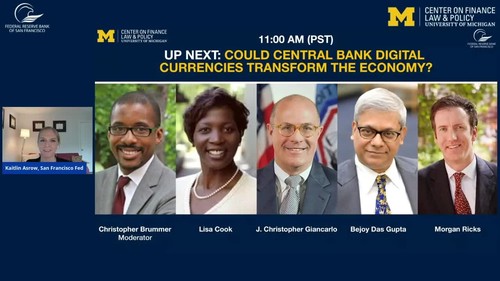
Chris Brummer of Georgetown Law School takes a deep dive on CBDCs with former CFTC Commissioner Chris Giancarlo, economist Dr. Lisa Cook from Michigan State University, Morgan Ricks of Vanderbilt Law School, and Bejoy Das Gupta of eCurrency. Learn mo...
Daniel Gorfine of the Digital Dollar Project offers an easy-to-follow primer on the basics of central bank digital currencies at the 2020 Central bank of the Future Conference.
This panel explores the regulatory perimeter between banking and fintech firms. Discussion focuses on whether bank chartering of fintech firms would advance or stifle innovation, safety and soundness, access, and consumer protection.
This panel evaluates ways that technological innovation in lending, derivatives clearinghouses, and payments systems may contribute to or help overcome systemic risk. Panelists also discuss cybersecurity and positive and negative network disruptions ...
This panel evaluates how regulators might be better equipped to foster innovation and protect consumers, investors, and the financial system as a whole.
This panel discusses whether and how fintech can contribute to financial inclusion—expanding access to sustainable financial products and services for low-and moderate-income households in the United States and developing world.